Metal roofing has been widely used in most industrial plants and some public buildings in China due to its light weight, economical cost,and fast construction speed. However,although metal roofing dominates the industrial roofing market, leakage problems caused by its inherent system characteristics have always been considered a persistent issue,affecting normal production and daily life.Taking the waterproofing repair of the roof of the Beijing Manton factory as an example, this paper analyzes the main causes of leakage in metal steel plate roofs and the selection of solutions.It introduces the application of the PVC waterproof membrane full-adhesion system in the renovation of this type of roof with leakage, including construction technology and key points of quality control.
Taking the Beijing Manton factory's profiled steel sheet composite insulated roof project as an example,on-site inspection revealed that the steel sheet was prone to deformation due to temperature and load deformation of the steel structure base layer.Under the influence of thermal expansion and contraction,wind loads,and foot traffic,the steel sheet lap joints loosened and opened,damaging the original waterproofing and causing leaks.Particularly at joints,where different materials were used for connection—such as the connection between the parapet wall and the gutter made of steel sheet,and roof skylights and other protruding parts of the roof—the asynchronous stress changes in the materials led to loosening at the joints,causing rainwater to seep directly into the building (Figure 1).
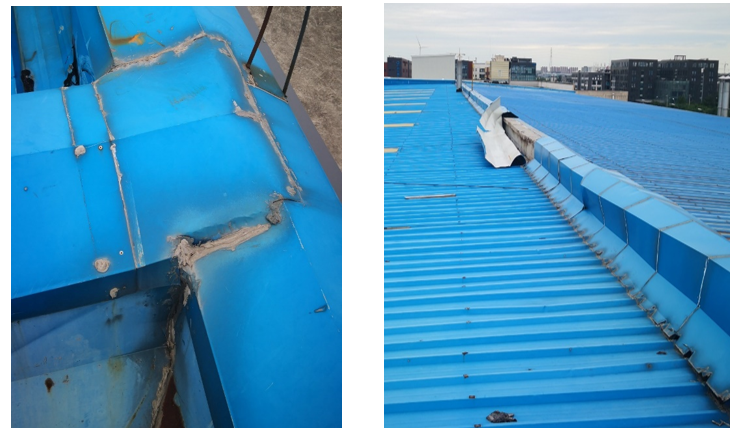
Figure 1. Failure of waterproofing measures at the junction of gable walls and other structures (left) and loosening and detachment of the metal flashing on the roof ridge (right).
01 What are the options for waterproofing and repairing metal roofs?
To address the increasingly serious leakage problem of profiled metal roofs,domestic practices currently typically involve using ordinary modified bitumen membranes or coatings for localized or overall repairs.Numerous failure cases demonstrate that these two material-based repair solutions cannot permanently resolve metal roof leakage issues,often leading to a cycle of "repairs,leaks,and more repairs."
Requirements and Characteristics of Metal Roof Waterproofing Repair:Metal roofs are exposed to the outdoors for extended periods and are greatly affected by natural conditions.Therefore,waterproofing treatment must conform to the characteristics of metal structures.The selected waterproofing materials should possess the following properties:
1) Good elasticity and tensile strength at break to withstand various vibrations and displacements of the roof;
2) Good weather resistance and resistance to UV aging;
3) Adaptability to various climates and a wide operating temperature range to ensure product performance at high and low temperatures and meet the requirements of temperature differences and sudden heating/cooling;
4) Seamless treatment of various irregularly shaped areas, etc.
Limiting Factors in the Design and Construction of Waterproofing Repair for Metal Roofs The repair plan for existing metal roof buildings is constrained by several factors,including:
1) minimizing or eliminating impact on the owner's normal indoor use;
2) requiring minimal noise, vibration, and odor;
3) employing hot air welding on-site, avoiding open flame operations, and minimizing pollution;
4) the strength, corrosion condition, and deformation degree of the steel plate;
5) the overall condition of the building (structure, settlement, cracks, leaks, or dripping);
6) roof wind load requirements;
7) load conditions: the material mass of the added repair layer must be less than 5 kg/m² (based on design load limits).
Waterproofing Renovation Solution Selection The Beijing Mankton Food Factory project only required the restoration of waterproofing functionality. Therefore, a full-adhesion system was adopted, tightly bonding PVC rolls to the steel plate surface using a special weather-resistant adhesive. Hot air welding was used at the overlap joints, resulting in a strong, reliable, and seamless joint. The specific implementation of the PVC roll roof waterproofing renovation solution used in this project is shown in Figure 2.

Figure 2. Construction diagram of roof renovation method
The advantages of using a full-adhesion PVC roofing membrane system for repairs include: 1) The thin and soft PVC waterproof membrane can be easily adhered to the corrugations of the profiled steel sheet.
2) Sika Sarnafil PVC waterproof membrane boasts excellent performance and is certified by BBA for a 35-year lifespan; its white surface has high solar reflectivity, minimizing heat absorption and enhancing the roof's thermal insulation and energy-saving effects.
3) The fiberglass reinforcement layer provides excellent dimensional stability and good resistance to mechanical impact, withstanding long-term wear from the steel sheet nuts; the non-woven backing provides both insulation and cushioning against the substrate, while also enhancing adhesion.
4) The membrane has a high elongation at break, allowing it to adapt well to substrate deformation.
5) Fewer roof layers, lower load, easier construction, and stronger wind uplift resistance.
02 How to carry out roof waterproofing renovation?
Construction sequence: Substrate cleaning → Laying and fully securing PVC waterproof membrane → Hot air welding of the membrane → Detail treatment.
Substrate requirements: The roof panel substrate must be treated before construction. The substrate must be thoroughly cleaned with water (or wiped clean with a damp cloth if this is not possible), and cleaning agents or thinners should be used if necessary, followed by complete drying. Severely rusted areas of the roof panel should be sanded down, and the substrate cleaned to meet the bonding requirements of the membrane (Figure 3).

Figure 3. Grinding and rust removal of the steel plate base (left) and removal of excess steel plate in the gutter area (right).
The PVC roll membrane is laid along the crests of the steel plate during full-adhesion construction, with overlaps welded at the troughs. First, pre-lay the membrane, arranging the loosely packed membrane on the substrate according to its outline, ensuring it is flat, straight, and free from twisting. Long side overlaps should be at least 80 mm; short side joints should be butt-welded using a 150 mm wide strip of non-composite PVC membrane.
Use a scraper (or roller) to evenly apply a layer of adhesive to both the membrane and the substrate. The recommended adhesive dosage is 0.5 kg/m². When the adhesive is semi-dry and not yet tacky, bond them together and compact them with a roller (Figure 4).

Figure 4. Bonding of rolled material to profiled steel sheet
For the long side overlap, hot air welding is performed directly using an automatic welding machine; for the short side butt joint, hot air welding is performed after overlapping with 150 mm wide non-composite roll material, and the weld width is not less than 25 mm (Figure 5).

Figure 5. The long side was welded using an automatic welding machine (left) and the short side was welded using a handheld welding machine (right).
03 How to handle detailed nodes?
Precast components matching the steel plate joints are fabricated on-site for steel plate joints such as ridges to ensure the reliability and aesthetics of the joints and improve construction efficiency (Figure 6).

Figure 6 Construction of steel plate joint nodes
For external gutter joints, the steel plate is cut off at the extended section of the gutter, and the roofing membrane is sealed to the inner gutter steel plate. Weather-resistant sealant is then applied to effectively prevent rainwater backflow into the room.
For roof penetration pipe joints, when laying the main roofing membrane, the corresponding section of the membrane is cut open to allow the pipe to pass through. The roof penetration pipe is then secured along the vertical edge with the membrane, with the lower end welded to the main roofing membrane. The upper end is then tightened with a metal clamp and sealed with sealant (Figure 7).

Figure 7. Wind turbine inlet node treatment
The original skylight at the roof skylight node had aged and failed. To ensure safety and the overall waterproofing of the roof, a steel plate was fixed over the original skylight, and a large PVC roll was fully adhered to the steel plate and welded over it (Figure 8).

Figure 8. Construction method of steel plate covered skylight joint.